
Posted on: January 27, 2026
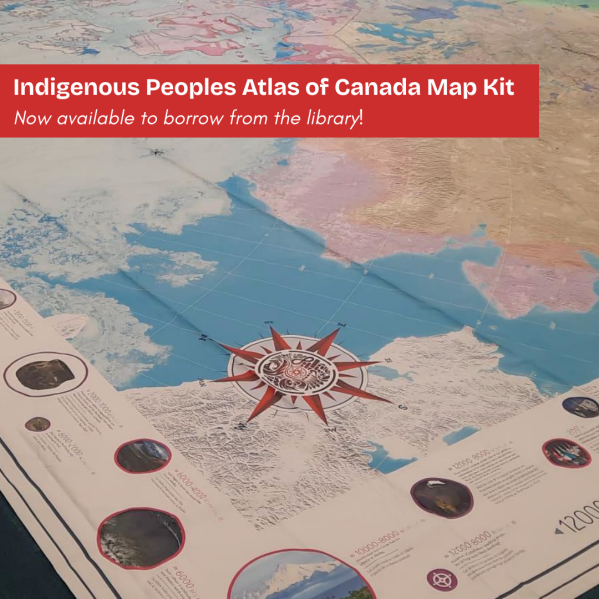
If you are looking for a powerful way to support learning about the histories, cultures and contemporary realities of First Nations, Métis and Inuit Peoples in Canada, the Indigenous Peoples Atlas of Canada Map kit is now available at the TRU Library.
Created through a national collaboration led by the Royal Canadian Geographical Society with Indigenous educators, the National Centre for Truth and Reconciliation, the Métis Nation, Inuit Tapiriit Kanatami, the Government of Canada and many other partners, the map is designed to shift how we see the land. Rather than showing political borders between provinces and territories, it highlights Indigenous language groups and cultural regions across what is now Canada. The result is a large and visually striking floor map that invites viewers to reconsider familiar geography through an Indigenous lens.
The map brings together information on Indigenous lands, languages, communities, treaties and cultural traditions. It also provides context for significant issues in Canada’s past and present, including colonization, racism, cultural appropriation and the residential school system. A detailed Residential School timeline helps learners understand how policies and institutions shaped generations of Indigenous families and communities.
More than a visual reference, the map is a flexible teaching tool. Educators will find lesson ideas, activities and learning outcomes that can be adapted for a wide range of ages and subjects. Whether you are hosting a classroom session or a workshop on campus, the map supports learning about the past, engagement with the present and meaningful conversations about the future of Indigenous Peoples in Canada.
Borrowing the Map Kit
The School of Education purchased the map, but it is housed at the TRU Library so the entire campus community can access it. Faculty and staff may borrow the kit with a valid TRU ID. The borrower is responsible for the map’s care and for coordinating all logistics, as scheduling with Facilities is needed. Borrowers must plan ahead because TRU Facilities needs time to schedule delivery and pickup. The kit cannot be borrowed on short notice.
Head on over to our guide to learn more about borrowing, loan periods, and how to request the map kit.
Learning Support
The Library does not provide facilitation or instructional support for the map. If you would like guidance on planning activities or want someone to lead learners through the resource, please contact Carolyn Anderson at caanderson@tru.ca.
Carolyn Anderson is an Assistant Teaching Professor and the Education Indigenous Student Facilitator in the Faculty of Education and Social Work. She can answer questions about the resource and is willing to attend sessions to support learning.
Learn More
To review the full borrowing process, find details on setup and care or explore teaching resources, please visit the Library’s guide to the Indigenous Peoples Atlas of Canada Map. If you have questions, please email us!